
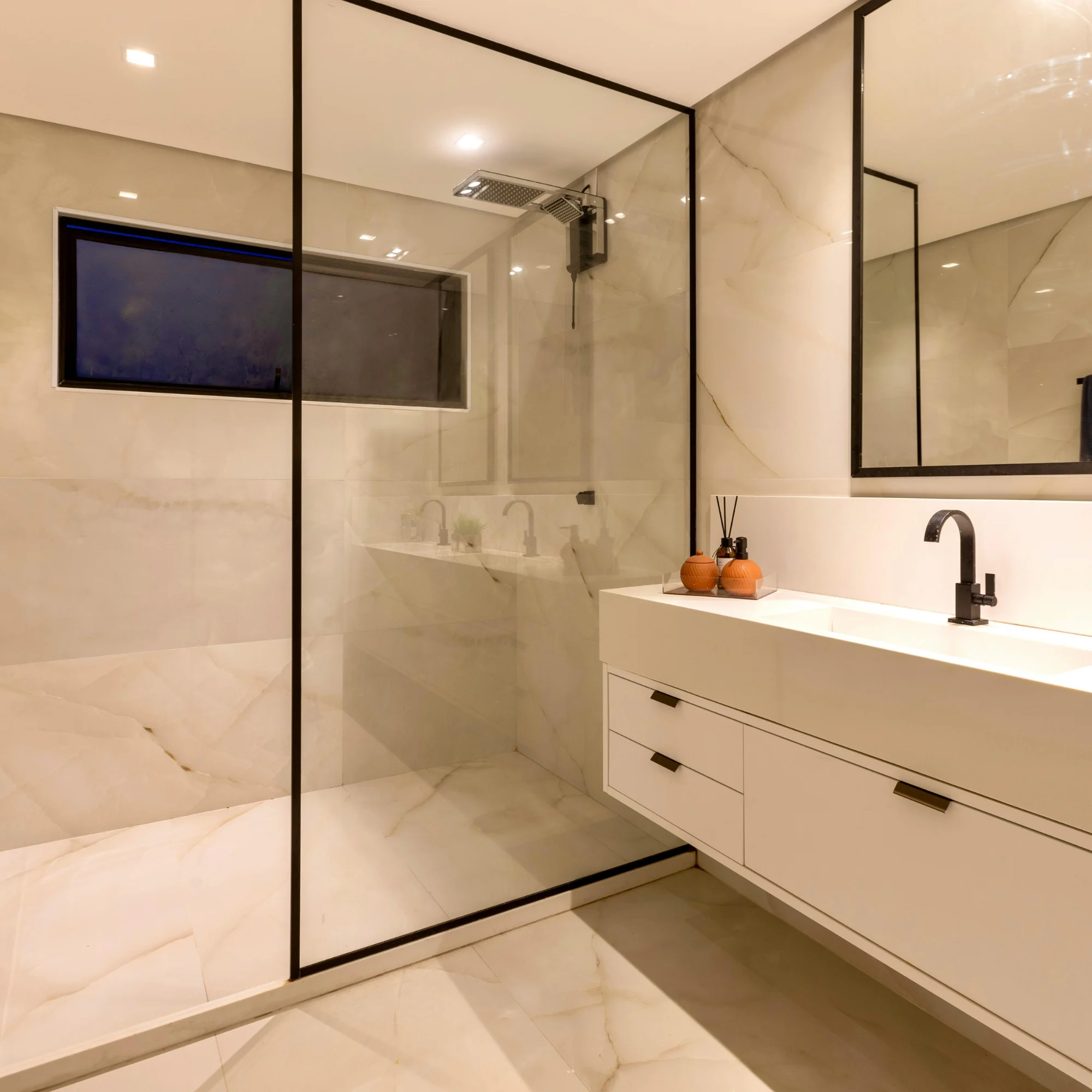
The room where marble ages fastest on board
Of all the stone on a yacht, the bathrooms take the hardest wear. Hot water, steam, soap, shampoo, perfume, sun cream and hard water from the tanks or the shore supply all meet the same polished surface several times a day. Yacht marble bathroom restoration is therefore the most frequent request we receive from interior teams, and often the most delicate one: the spaces are small, the finishes are fine and the joinery around the stone is usually as valuable as the stone itself.
We restore vanities, basins, shower trays, shower walls, bath surrounds and floors directly on board, with the same approach used by Les Traitements du Sud, the stone-care company that looks after yachts on the Côte d’Azur. The aim is simple: bring each surface back to the finish it had when the yacht left the yard, without removing anything that does not need to be removed, and leave the crew with a routine that keeps it that way.
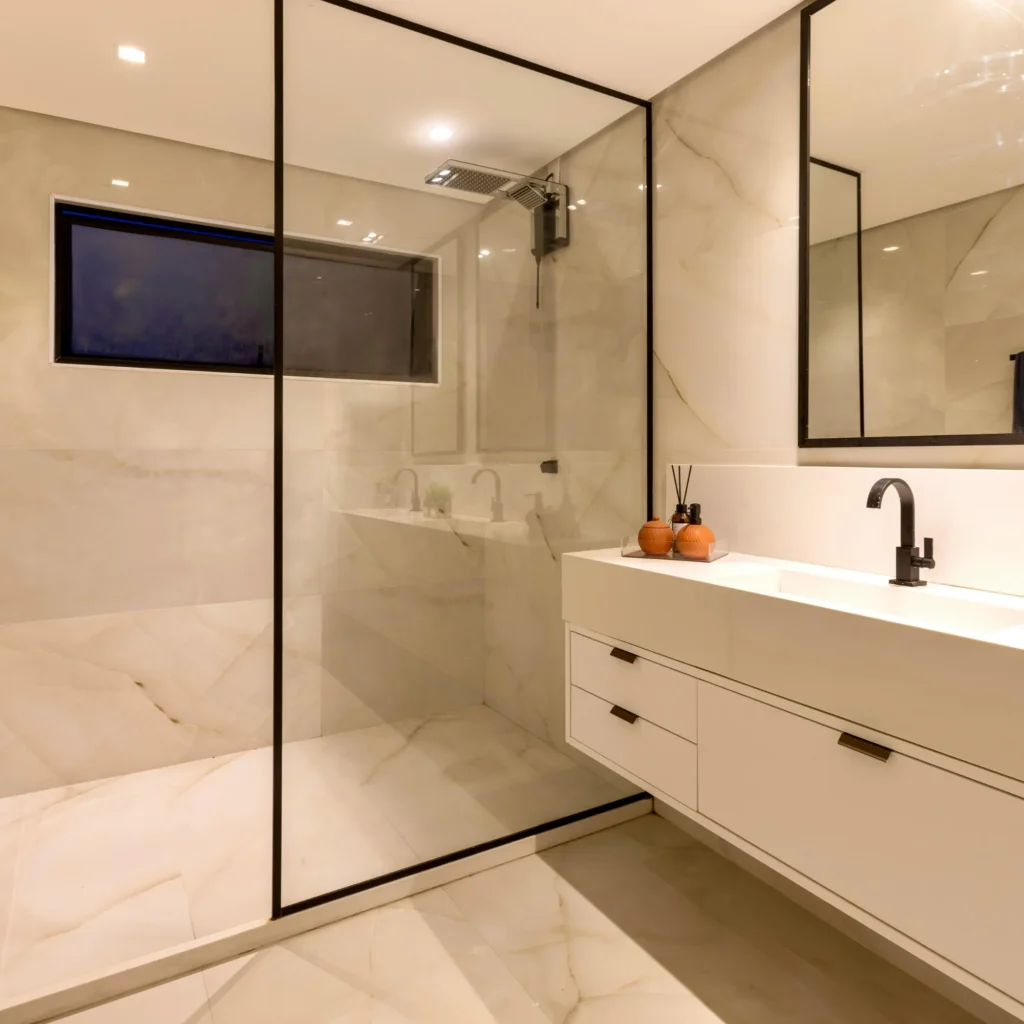
What we see in yacht bathrooms
Bathroom stone rarely fails all at once. It loses its finish in patches, usually where people stand, lean or put things down. Before quoting, we ask the crew for a few close-up photos taken with the light raking across the surface, because that is where the real condition shows.
- Etch marks on vanities. Perfume, aftershave, toothpaste, lemon-based cleaners and many cosmetics are acidic. On calcite marble they leave dull rings and drips that no cloth will remove.
- Limescale on shower walls and trays. Hard water dries into a white film, then into a crust around taps, drains and glass profiles.
- Dull, uneven shower trays. Constant water, soap residue and the wrong cleaning products wear the polish away first where the water lands.
- Yellowed or black silicone joints. Mould and soap trapped in old sealant spoil an otherwise clean bathroom and can let water reach the substrate.
- Chips at edges and corners. A dropped bottle or a heavy toiletry bag is enough to break a vanity edge or the lip of a basin.
- Rust spots. Hairpins, razors or a metal shelf left on wet stone can leave orange stains that sink into the surface.
Yacht marble bathroom restoration, surface by surface
Each part of a bathroom needs a different treatment. We assess the stone first, then choose the lightest intervention that will bring it back. A vanity with a few etch rings does not need the same work as a shower tray that has lost its polish entirely.
Vanities and basins
Vanity tops are where cosmetics do their damage. Light etching is removed by local re-polishing with fine abrasives and polishing compounds, blended into the surrounding surface so the repair does not show. Deeper marks need honing before polishing. Chips at the edge are filled with a tinted resin matched to the veining, then shaped and polished. Our etch mark removal and marble repair pages explain both in detail.
When a vanity top can be removed easily and the crew prefers, it can also be taken to a workshop close to the yacht and returned once finished.
Shower walls
Walls are usually less worn than trays, but they collect limescale, especially near the shower head and along glass profiles. We dissolve the deposits with products that are safe for calcite, then restore the polish where the scale has already started to etch the stone.
Shower trays
Many shower trays on yachts are honed or lightly textured for grip. We respect that: a tray that was honed at the yard is brought back to an even honed finish, not polished to a slippery gloss. When a tray was polished originally, we discuss grip with the captain before restoring it as it was.
Floors
Bathroom floors suffer from water, wet feet and sand carried in from the deck. The method is close to the one described on our marble floors page, with extra care around toilets, joinery plinths and door thresholds.
Silicone joints
Old sealant is cut out cleanly, the joint is cleaned and dried, and a new sanitary silicone is applied in a colour chosen with the chief stew. It is a small job, but it changes the whole look of a shower.
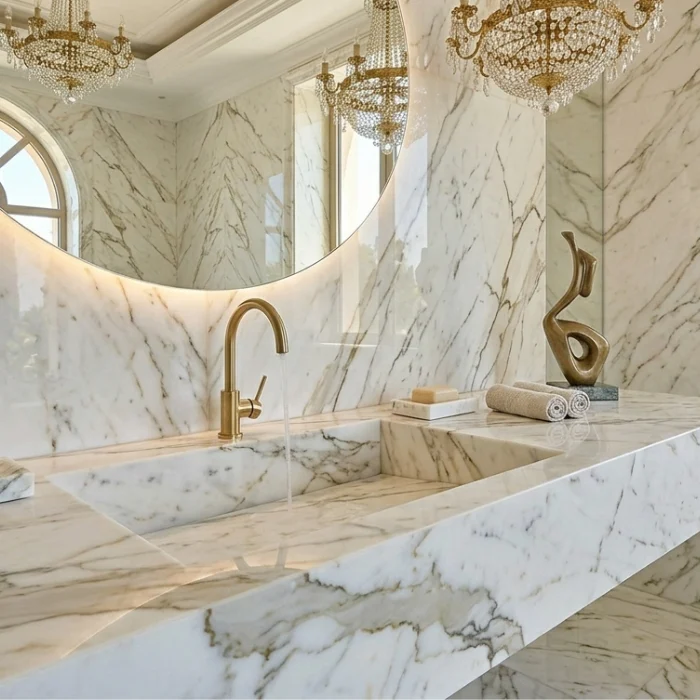
Onyx, backlit panels and soft marbles
Designers often choose onyx for owner’s bathrooms: translucent, sometimes backlit, always spectacular. It is also softer and more brittle than most marbles, and it reacts quickly to acids. Etching shows more clearly on onyx because light passes through the stone, and resin repairs must be matched for translucency as well as colour.
We work on onyx with lower pressure, finer abrasive steps and more frequent checks, and we test every product on a hidden area first. For backlit panels, the lighting is switched off and the electrical side is left to the crew or the yard. Travertine, granite and quartzite in bathrooms are treated with the same care, each according to its own hardness and porosity.
Planning around who uses the bathroom
A yacht does not have one bathroom but several, used by very different people. We plan accordingly with the captain or the chief stew.
Guest suites
Guest bathrooms are the busiest during the charter season and the ones that charter guests inspect first. They are best restored before the season starts, then checked between charters. On a short turnaround we can concentrate on the visible damage, such as vanity rings or a dull tray, and leave deeper work for the yard period. A maintenance contract makes these visits routine rather than urgent.
Owner’s suite
The owner’s bathroom often holds the rarest stone on board and is used less by guests, but it carries the highest expectations. We schedule it when the owner is away, keep the team small and discreet, and treat the room as private space: nothing is photographed without the captain’s agreement, and a non-disclosure agreement is available on request.
Crew bathrooms
Crew areas use simpler stone, or none, but when there is marble it deserves the same attention. These rooms can usually be done while the crew carries on working elsewhere, and are a good place to agree on cleaning products that will then be used throughout the yacht.
How we work in a confined bathroom
A yacht bathroom is a small, enclosed space surrounded by lacquered joinery, mirrors, fabrics and fittings. The working method matters as much as the result. The full sequence is described on our how we work on board page; here is what changes in a bathroom.
- 01
Protect everything that is not stone
Joinery, mirrors, taps, glass and the corridor carpet are covered before any tool is switched on. Doors are protected on both sides.
- 02
Control water and dust
Wet work is contained, slurry is collected as we go and dust is extracted at source. Drains are protected so that no residue goes into the yacht’s grey water system.
- 03
Use products suited to closed spaces
We choose low-odour products where possible and keep the room ventilated, in coordination with the engineer if air conditioning needs adjusting.
- 04
Finish, seal and hand over
Once the finish matches, the stone can receive an impregnating marble protection treatment. We check the result with the chief stew and leave written care advice.
We come to your yacht, wherever she is
Bathroom work is usually carried out alongside in the marina, between charters or while guests are ashore. It can also be done at anchor when access allows, or in the shipyard during a refit or winter lay-up, which is the best moment for full restorations of every bathroom on board. The team travels to the yacht in each of our ports across Spain, Italy, Malta, Croatia, Greece and Portugal.
Bathrooms are rarely the only stone on board. If the yacht also has marble in the saloon, on the bar tops and tables or on the stairs, it is often worth planning everything in one visit.
Keeping bathroom marble right between visits
Most bathroom damage is caused by products, not by use. A few habits make a real difference:
- Use a pH-neutral stone cleaner, never a bathroom limescale remover
- Dry shower walls and trays with a squeegee and microfibre after use
- Put guest cosmetics on a tray rather than directly on the vanity
- Wipe perfume and toothpaste drips at once, without rubbing
- No vinegar, lemon, bleach or abrasive cream on marble or onyx
- Report new dull marks early: fresh etching is quicker to remove
Our page for captains and crew goes further, with a list of what not to use and what to send us when you need help.
Questions about marble bathrooms on yachts
Can a bathroom be used again the same day?
Often yes for light work such as etch mark removal on a vanity. After honing, polishing and a protective treatment, we usually ask for the bathroom to stay dry for a period that we confirm on the day, depending on the product used.
Do you need to remove the vanity top?
No. Almost all bathroom work is done in place. Removing a top is only an option when it is easy to take out and the crew prefers workshop treatment.
Will a polished shower tray become slippery?
We restore the finish the tray had originally. If it was honed for grip, it stays honed. If you would like a change, we discuss it with the captain first.
Can you treat onyx bathrooms?
Yes. Onyx needs gentler methods and careful testing, and resin repairs must match its translucency. We assess it in person before committing to a result.
Do you replace silicone joints?
Yes, around trays, basins and wall junctions, as part of a bathroom restoration. The colour is agreed with the chief stew beforehand.
What should we send for a first estimate?
A few photos of each bathroom, close-ups of the damage with light across the surface, the yacht’s location and the dates when the bathrooms are free. WhatsApp is the easiest way.
Tell us about your yacht
Send a few photos on WhatsApp: we reply with a first assessment and propose a slot that fits the crew’s schedule.