
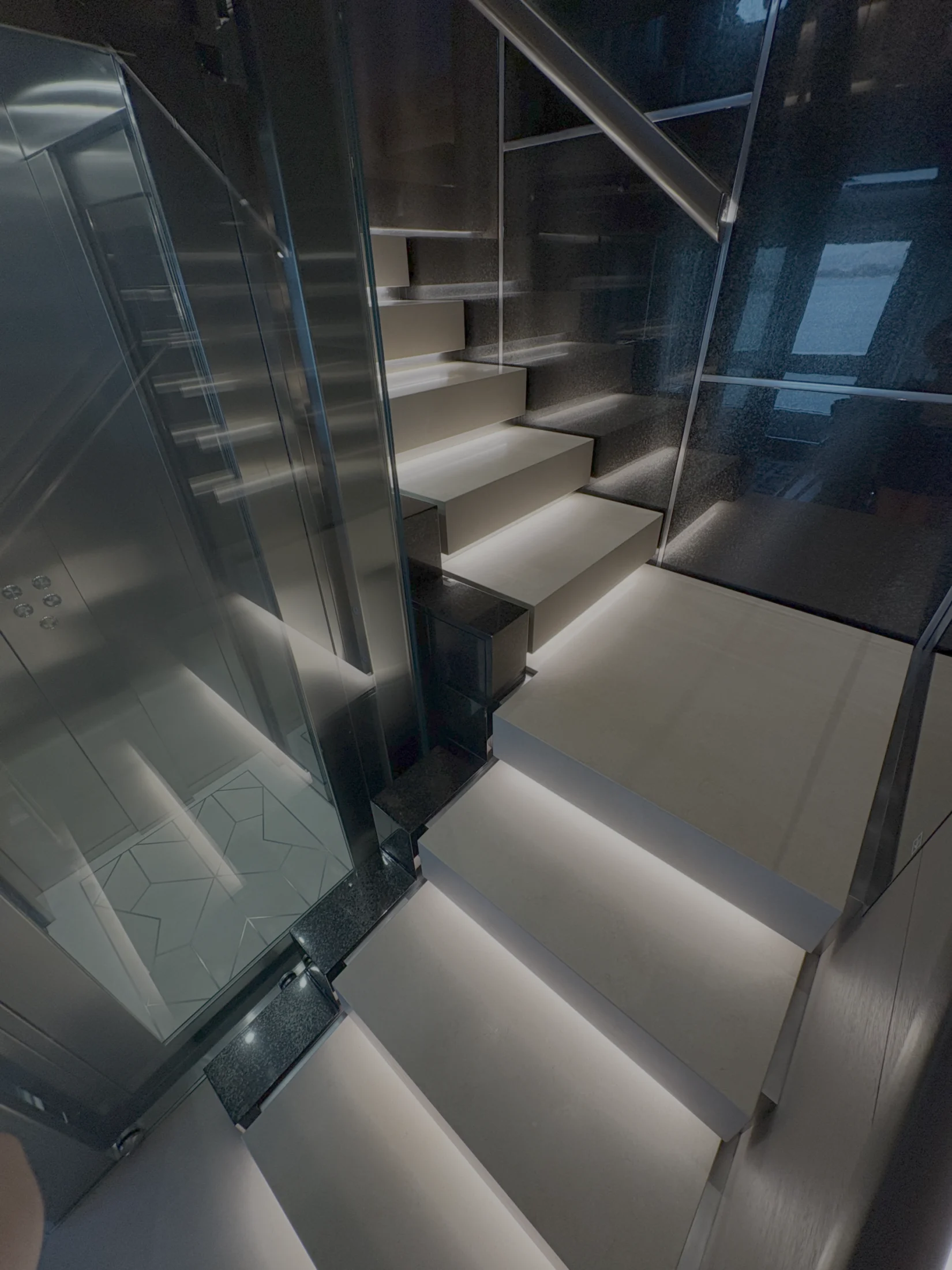
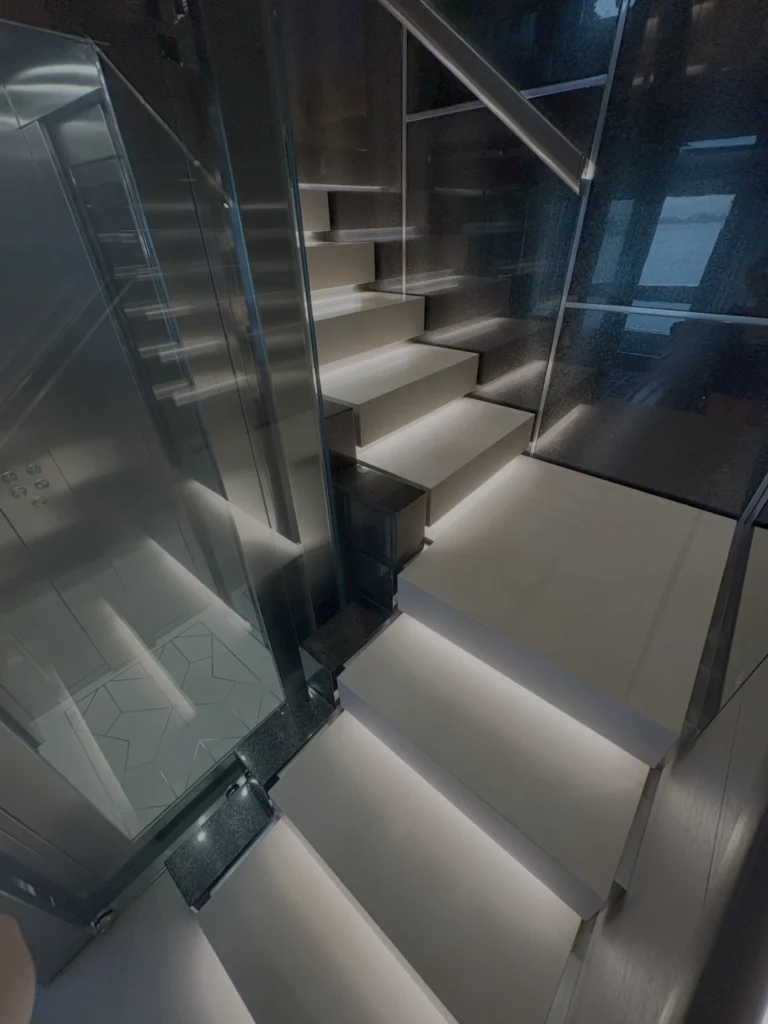
A staircase is used by everyone, all day
On many yachts the main staircase links the lower deck lobby to the main saloon and the bridge deck. Guests use it, crew use it with trays and laundry, contractors use it with tools. It is often designed as a centrepiece, with fine marble treads, polished nosings and sometimes onyx or backlit details. It is also where wear concentrates: in the centre of each tread, along the nosings and on the first and last steps.
Marble stairs restoration on a yacht brings back an even finish on every tread, repairs chipped nosings and broken corners, and keeps the grip the staircase needs at sea. We carry out this work on board with the methods of Les Traitements du Sud, the stone-care company that looks after yachts on the Côte d’Azur.
How marble stairs wear on board
Stairs combine all the stresses of a floor with impacts and constant handling.
- Dull walking paths in the centre of each tread
- Chips and cracks on nosings, where heels and objects strike
- Broken corners at the junction with the stringer or the balustrade
- Scratches from sand carried up from the deck
- Etch marks from drinks carried between decks
- Open or cracked joints between tread and riser
- Discoloured stone along handrail fixings and metal trims
Marble stairs restoration, part by part
A staircase is a series of small, three-dimensional surfaces. Each part needs its own approach.
Treads
Treads carry the wear. They are honed where the walking path has dulled or scratched the stone, then brought back to the agreed finish so that every step matches the next. The work is done by hand or with compact machines suited to the size of a tread.
Risers
Risers are vertical and less worn, but they collect scuffs from shoes and marks from cleaning equipment. They are usually cleaned, locally re-polished and protected.
Nosings
The front edge of each step takes the impacts. Chips are filled with a tinted resin matched to the stone and veining, then reshaped to the original profile, whether square, eased or bullnose, and polished. Cracked nosings are consolidated first. See marble repair.
Landings
Landings behave like floors and are restored with the same method as our marble floors, so that the finish flows from the floor to the first step without a visible line.
Spiral and curved staircases
Curved and spiral staircases, common between the main and upper decks, have treads of varying width and curved nosings. Each tread is worked individually, the resin repairs follow the curve of the edge, and we take particular care where the treads meet a glass or metal central column.
Grip comes first on a moving yacht
A staircase at sea has to be safe in a swell, with wet feet, in bare feet and in the dark. That matters more than gloss. Many yacht staircases have honed treads, anti-slip strips or a textured band near the nosing for exactly this reason.
When we restore a staircase, we keep the slip resistance the designer intended. A honed tread is restored to an even honed finish, not polished. If treads were originally polished and the captain is concerned about grip, we discuss options before starting: a satin finish on the walking area, keeping or renewing existing anti-slip inserts, or a polished riser with a honed tread. Any change is tested on one step and agreed with the captain, who has the final word on safety on board.
We do not apply treatments that would make a stair surface slippery, and we avoid wax-based products on treads altogether.
Working on stairs while the crew still needs to get through
On most yachts the main staircase cannot simply be closed for days. The crew has to serve the saloon, reach the guest cabins and move between decks. We plan the work so the yacht keeps moving.
- 01
Agree the alternative route
With the captain or first officer, we confirm which crew staircase or passage can be used while the main stairs are being worked on, and for how long.
- 02
Work in sequence
Where there is no alternative, we work every other step or one side of the tread at a time, so that a safe path stays open. The steps being worked on are clearly marked.
- 03
Protect the surroundings
Handrails, balustrades, glass panels, wall panels and the carpet at the top and bottom of the stairs are masked. Dust is extracted at source and slurry collected as we go.
- 04
Respect curing times
Resin repairs and protective treatments need time to cure. We tell the crew exactly which steps can be used and when.
- 05
Check together
We walk the staircase with the chief stew or first officer at the end, checking finish and grip on each step before the masking comes off.
When to schedule it
Stairs are best restored when traffic is lowest: between charters, with the owner away, or in the shipyard during a refit or winter lay-up. Small repairs to a chipped nosing can be done alongside in a short slot. We come to your yacht, wherever she is: alongside in the marina, at anchor if access allows, or in the yard. Our team travels to the yacht in each of our ports.
Together with the rest of the interior
A staircase rarely stands alone. The lobby floor at its foot, the saloon at the top, a bar or table nearby and the guest bathrooms along the corridor can all be planned in the same visit, which avoids masking the same areas twice.
What a staircase restoration may include
The exact scope depends on the condition of the stone. These services are often combined on stairs:
Marble repair
Chips, cracks and broken corners.Read more Treads and risersMarble polishing
An even finish on every step.Read more SpillsEtch mark removal
Drinks carried between decks.Read more After workMarble protection
Impregnation that keeps grip.Read moreFor suitable marbles on risers or decorative elements, crystallisation may be proposed; we do not use it on treads where it would reduce grip. A maintenance contract includes a check of the nosings at each visit, so small chips are filled before they grow. The organisation of a visit is explained on our how we work on board page.
Daily care for marble stairs
Stairs are hard to clean well because every step has edges and corners. Dust-mop treads daily with a clean microfibre, then damp-wipe with a pH-neutral stone cleaner and dry. Never use polish, wax or oily products on treads. Ask contractors to protect the stairs when carrying equipment, and report a chipped nosing early: a small chip is quick to fill, a large one can crack further.
Questions about marble stairs on yachts
Will the stairs be more slippery after polishing?
No. We restore the grip the staircase was designed with. Honed treads stay honed, and any change of finish is tested and agreed with the captain first.
Can the crew use the stairs while you work?
Usually yes, by working in sequence or using an alternative route agreed in advance. Steps under repair or treatment are clearly marked.
Can a broken nosing be repaired without replacing the tread?
In most cases yes. Chips and broken corners are rebuilt with tinted resin, reshaped and polished. Replacement is only worth discussing when the stone is badly cracked through.
Do you protect the handrails and glass balustrades?
Yes. Handrails, glass, metal trims and adjoining carpets are masked before work starts and checked again at the end.
Can you match a repair on onyx or strongly veined marble?
Yes, with resin tinted and, for onyx, adjusted for translucency. We show the crew the repair before final polishing.
How long does a staircase restoration take?
It depends on the number of steps, the stone and the condition of the nosings, and on whether we can close the stairs or must keep a path open. We give a realistic schedule after seeing photos or the staircase itself, and we confirm it with the captain before starting.
Tell us about your yacht
Send a few photos on WhatsApp: we reply with a first assessment and propose a slot that fits the crew’s schedule.