The surfaces that live with food and drink
Bar tops, galley counters, dining tables and coffee tables are the marble surfaces people touch most, and the ones that meet acids most often. A glass of white wine, a slice of lime, a bottle of olive oil, a hot dish, a vase with flowers: each can leave a mark on polished marble within minutes. Marble bar top and table restoration on a yacht brings these pieces back to an even finish, removes rings and dull marks, repairs chipped edges and leaves a protection that makes the next spill easier to deal with.
Our methods come from Les Traitements du Sud, the stone-care company that looks after yachts on the Côte d’Azur. The photographs on this page show real work on yacht tables carried out by that team.
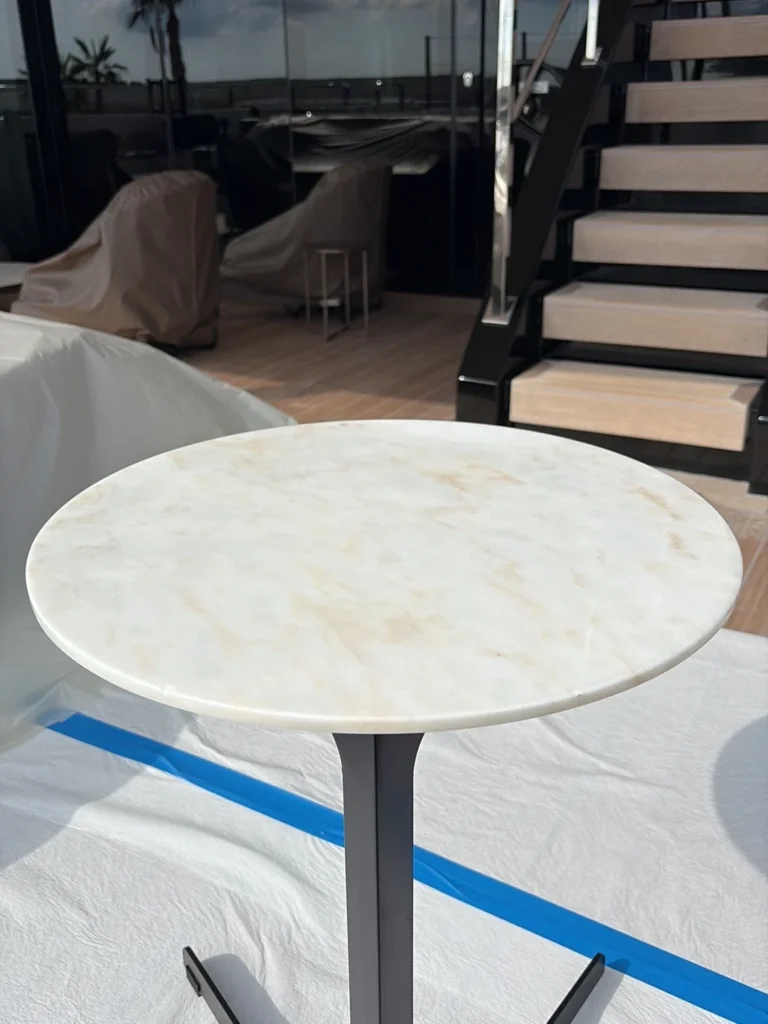
A round deck table, after polishing
This round table had lost its gloss under sun, salt and the usual traces of drinks served on deck. It was honed to remove the etching, then polished in place, with the base and the surrounding deck masked by protection tape that you can still see in the picture.
Outdoor tables age faster than those inside: ultraviolet light, salt spray and rain all work on the surface, and sun cream on hands adds its own residue. They benefit from a marble protection treatment after every restoration.
What leaves marks on bars and tables
Knowing the cause helps choose the cure. These are the marks we see most:
Wine and citrus rings
White wine, champagne, cocktails, lemon and lime are acidic. On calcite marble they dissolve the polished surface and leave a dull ring the shape of the glass. These are etch marks, not stains: cleaning will not remove them, re-polishing will. See etch mark removal.
Oil and grease stains
Olive oil, butter and cosmetic oils soak into porous stone and darken it. They are drawn out with a poultice before any polishing.
Scratches from glasses and bottles
Glasses, bottles, ice buckets and decorative objects slid across a bar leave a network of fine scratches that dull the area where service happens.
Chipped edges
Bar edges and table corners take knocks from trays, chairs and bottles. Chips are filled with tinted resin, reshaped to the original profile and polished. See marble repair.
Marble bar top and table restoration, step by step
The video shows a table top being honed. This is the step that removes etching and scratches by taking off a very thin, even layer of stone. It is followed by finer grits and polishing until the gloss matches the original finish.
- Assessment of the stone, the finish and the edge profile
- Masking of the base, the joinery around a bar and any nearby fabric
- Removal of oil stains by poultice where needed
- Honing of etched or scratched areas, then of the whole top if required for an even result
- Tinted resin repair of chips
- Polishing, or crystallisation on suitable marbles
- Impregnating protection and handover with the chief stew
Bars, galley counters, dining and coffee tables
Each piece has its own rhythm of use and its own constraints.
Bar tops
The most exposed surface on board for acid etching. Best restored before the season and checked between charters. The joinery and bar stools around are protected.Coffee tables
Strongly veined marbles show every ring. We match the polish precisely so the veining reads cleanly again.Dining tables
Large tops where an even finish matters from end to end. Partial repairs are blended so that no patch shows under the lights.Side and deck tables
Sun, salt and rain wear outdoor tables quickly. Protection is essential after restoration.Galley counters deserve a special mention. They work hard every day, meet lemon juice, vinegar, tomato and hot pans, and are cleaned with products that are often too strong for marble. We restore them during a quiet period agreed with the chef, and recommend cleaning products the galley team can actually use in service.
In place, on board
Most bars, counters and fixed tables are restored where they stand. We come to your yacht, wherever she is: alongside in the marina, at anchor when access allows, or in the shipyard during a refit or winter lay-up. Our team travels to the yacht in each of our ports.
Removable tops in a workshop
Some table tops and smaller counters can be lifted off easily. When that is the case and the crew prefers, the top can be taken to a workshop close to the yacht, restored there without any dust on board, and returned and refitted. We agree on handling, packing and transport beforehand.
Crystallisation on a design table
Crystallisation gives suitable marbles a harder, brighter surface that holds up better to daily use. It is not right for every stone, so we test first. The video shows the treatment on a design table in a saloon.
The full method on board, from first message to handover, is described on our how we work on board page.
Keeping bar tops and tables clean between visits
Interior and galley teams can prevent most damage with a few simple rules:
- Coasters under every glass, especially wine and cocktails
- Cut citrus on a board, never directly on marble
- Wipe spills immediately with a damp cloth, then dry
- Trays under bottles, oils and flower vases
- pH-neutral stone cleaner only, no vinegar or limescale remover
- Felt pads under decorative objects and lamps
More advice for interior teams is on our page for captains and crew. Other surfaces on board: marble floors, marble bathrooms and marble stairs. A maintenance contract keeps bars and tables at their best through the season, and marble polishing explains the core of our work.
Fitting the work around service
Bars and dining tables are in use almost every day the yacht is occupied, so timing matters more here than on any other surface. Local etch removal on a bar top can often be done in the morning, before the first drinks are served, or while guests are ashore for lunch. A full restoration of a dining table or a long bar is better placed between charters, during a quiet week with the owner away, or in the yard.
Before we arrive, it helps if the interior team clears the surface completely: bottles, glassware, decorative objects, lamps and place settings. We check together which pieces of furniture can be moved and which must stay, and the chief stew tells us where the team can work without crossing the guest areas. When the galley is involved, we agree the slot with the chef so that meal preparation is never interrupted.
Removable tops sent to a workshop need a little more lead time for packing and transport, but they free the saloon or the deck entirely while the work is done.
Questions about bar tops and tables
Why did a ring appear when we only wiped up some wine?
Because the acid acted before the wipe. On calcite marble, a few minutes are enough to dissolve the polish. The ring is a small area of etched stone and needs re-polishing, not cleaning.
Can you remove one ring without redoing the whole table?
Often yes, by local re-polishing blended into the surrounding finish. On large, uniformly polished tops with many marks, treating the whole surface gives a more even result.
Can a removable table top go to a workshop?
Yes, if it can be lifted out safely. We agree on packing and transport with the crew, restore it in a workshop near the yacht and bring it back.
Is the bar usable on the same day?
After local etch removal, usually yes. After a full restoration with protection, we give the crew a time for the surface to rest, depending on the product used.
Do you work on granite or quartzite galley counters?
Yes. Granite and quartzite are harder and less sensitive to acids, but they still dull, stain and chip. We adapt the abrasives and products to each stone.
What protection do you recommend for outdoor tables?
An impregnating water and oil repellent after restoration, renewed periodically. It does not stop acid etching entirely, but it slows stains and makes daily cleaning easier.
Tell us about your yacht
Send a few photos on WhatsApp: we reply with a first assessment and propose a slot that fits the crew’s schedule.