

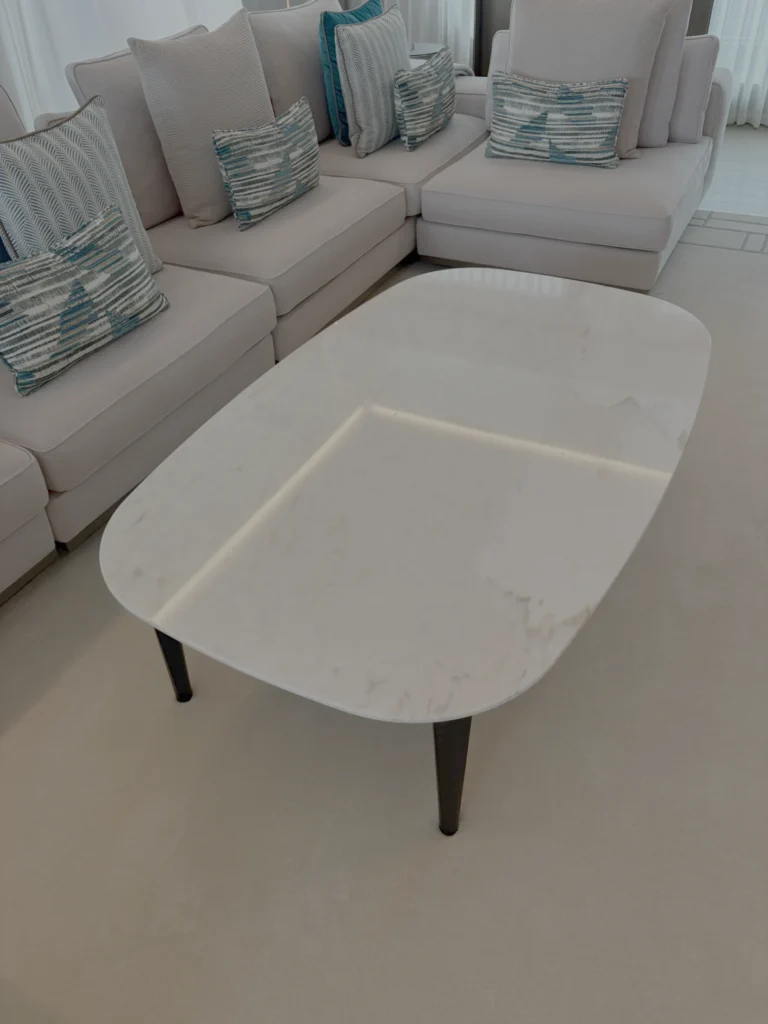
Chips, cracks and broken edges, mended where they happened
Yacht marble repair deals with the damage that polishing cannot touch: a chipped vanity edge where a heavy bottle fell, a hairline crack across a floor tile near a hatch, a bar top corner knocked during provisioning, a stair nosing broken by a dropped case. On a yacht, stone is laid on structures that flex and vibrate, so it is exposed to stresses a building never sees.
We repair marble on board, in place, so that the piece keeps its original position, veining and fit. Replacing a slab is sometimes unavoidable, but it means sourcing matching stone, templating, cutting and fitting, often during a refit. A good repair is quicker, far less invasive and, done properly, close to invisible at normal viewing distance.
What we repair
Chips and broken edges
Vanity and counter edges, table rims and bullnose profiles. The missing volume is rebuilt with a tinted resin, then shaped and polished to the original profile.Cracks and fissures
Hairline cracks are cleaned and filled with a fluid resin that penetrates by capillarity. Open cracks are stabilised before filling. We look for the cause before closing anything.Holes and open pores
Travertine fills that have washed out, pinholes in marble and old fixings left behind after a refit are filled and levelled with the surrounding surface.Steps and nosings
Broken stair nosings are rebuilt so that the step is safe again, then finished to match the tread. Stairs are the place where a repair must above all be solid.Yacht marble repair: how a filling is done
The quality of a repair depends on two things: how well the filling bonds, and how well its colour and translucency match the stone. Marble is not a flat colour. It has a background, veins, crystals and a depth that changes with the light. A resin that matches in daylight can look grey under warm LED strips, so we match under the lighting the piece will be seen in.
- 01
Diagnose
We check whether the damage is purely cosmetic or structural. A crack that keeps growing may point to a substrate that moves, an unsupported edge or a loose tile. Filling it without telling you would only hide a problem for a few weeks.
- 02
Clean and prepare
Dust, old filler, sealer and cleaning residue are removed from the damaged area so the resin bonds to sound stone. Edges of a chip are lightly freshened.
- 03
Tint the resin
Resin is tinted with mineral pigments in small trial batches, compared directly against the stone. For veined marble, a vein can be continued across the repair by hand.
- 04
Fill and cure
The resin is applied slightly proud of the surface and left to cure. The crew is told how long the area must stay untouched.
- 05
Level, shape and polish
The excess is cut back flush, the profile is shaped, and the area is honed and polished with the surrounding stone so the sheen is continuous.
What a repair can do
- Rebuild a missing edge or corner to the original profile
- Close hairline cracks and stop dirt from entering them
- Restore a safe, solid stair nosing
- Blend a filling into the colour and sheen of the stone
- Avoid removing a slab during the season
What we will be honest about
A repair on a pale, translucent stone or on onyx is never 100% invisible under close, raking light. On a busy veined marble it often is. We tell you, before starting, what level of result to expect.
If a crack comes from a structural cause, such as a tile laid without full support or a deck that flexes, we flag it to the captain or the yard. The cause needs dealing with before a lasting repair is possible.
When a slab is shattered or the missing piece is very large, replacement may be the better solution. We will say so.
Working on board without disturbing the yacht
Most repairs are small, local jobs, which makes them easy to fit into a yacht’s day. A single chipped vanity can be repaired in a guest bathroom while the rest of the yacht carries on. Where grinding or polishing is needed, the area is protected first: masking on joinery and leather, covers on carpets, closed doors and wet work with extraction at the source. Resins are chosen and used with ventilation in mind, because a cabin is a confined space.
The team comes to the yacht alongside in the marina, at anchor if access is practical, or in the shipyard during refit and lay-up, which is a good moment for repairs on floors and stairs. Removable pieces, such as a tabletop or a loose vanity top, can be repaired in a workshop near the yacht if you prefer. Our on-board method describes the whole process, and the ports page lists the harbours our team travels to.

Where damage usually appears on board
Bathrooms: vanity edges chipped by bottles and hair tools, shower trays with cracks near the drain.
Floors: cracked tiles near hatches, door thresholds and areas over flexing structure.
Bars and tables: chipped corners and edges, the occasional crack from a heavy object or a hard landing at sea.
Stairs: broken nosings and loose treads, a priority for crew and guest safety.
Repair now, or wait for the yard period?
Not every chip needs to be fixed the same week. A simple rule helps captains and managers decide.
- Repair straight away: anything that cuts, catches or trips. A sharp chipped edge on a vanity, a broken stair nosing, a lifted tile corner. These are safety issues for guests and crew, and they are usually quick jobs that fit between two charters.
- Repair soon: open cracks in wet areas and around drains. Water, soap and cleaning products get into the crack, stain it from inside and can reach the substrate.
- Can wait for the yard: purely cosmetic hairline cracks on dry surfaces, old fillings that have yellowed, and series of small chips across a large floor. Grouping them during a refit or lay-up keeps disruption low and lets us finish the whole floor evenly.
Whatever you decide, a clear photo record of the damage helps the yacht manager keep track of it, and helps us plan the right materials before we come on board.
After the repair
A repair is usually the first step of a wider job. Once the surface is sound, polishing evens out the sheen around it, etch mark removal deals with dull rings nearby, and crystallisation can finish a calcareous floor. A penetrating protection keeps stains out of the stone and the filling. For yachts with a lot of stone on board, a maintenance contract catches small chips before they grow.
Marble repair questions
Will the repair be visible?
On veined or coloured marble, a well-matched repair is usually very hard to spot. On pale, uniform or translucent stones like onyx, a close look under raking light may still reveal it. We show you a colour test before filling.
Can a cracked floor tile be repaired rather than replaced?
Often yes, if the tile is still well bonded and the crack is stable. If the tile is loose or the crack keeps opening, the cause must be fixed first, and replacement may be the better option.
How long before the area can be used again?
It depends on the resin and the temperature on board. Small fillings are typically usable the same day; we give the crew a precise time before we leave.
Do you repair onyx, granite and quartzite too?
Yes. Onyx needs particular care because it is soft and often translucent. Granite and quartzite are harder and are repaired with resins suited to their colour and finish.
Can you repair a broken stair nosing between two charters?
In most cases, yes. Nosing repairs are relatively quick and are treated as a priority because a broken step is a safety issue for guests and crew.
What photos should we send for a quote?
One photo of the whole piece, one close-up of the damage with a coin or ruler for scale, and one in normal interior lighting. Send them on WhatsApp and we will reply with a first opinion.
Tell us about your yacht
Send a few photos on WhatsApp: we reply with a first assessment and propose a slot that fits the crew’s schedule.