
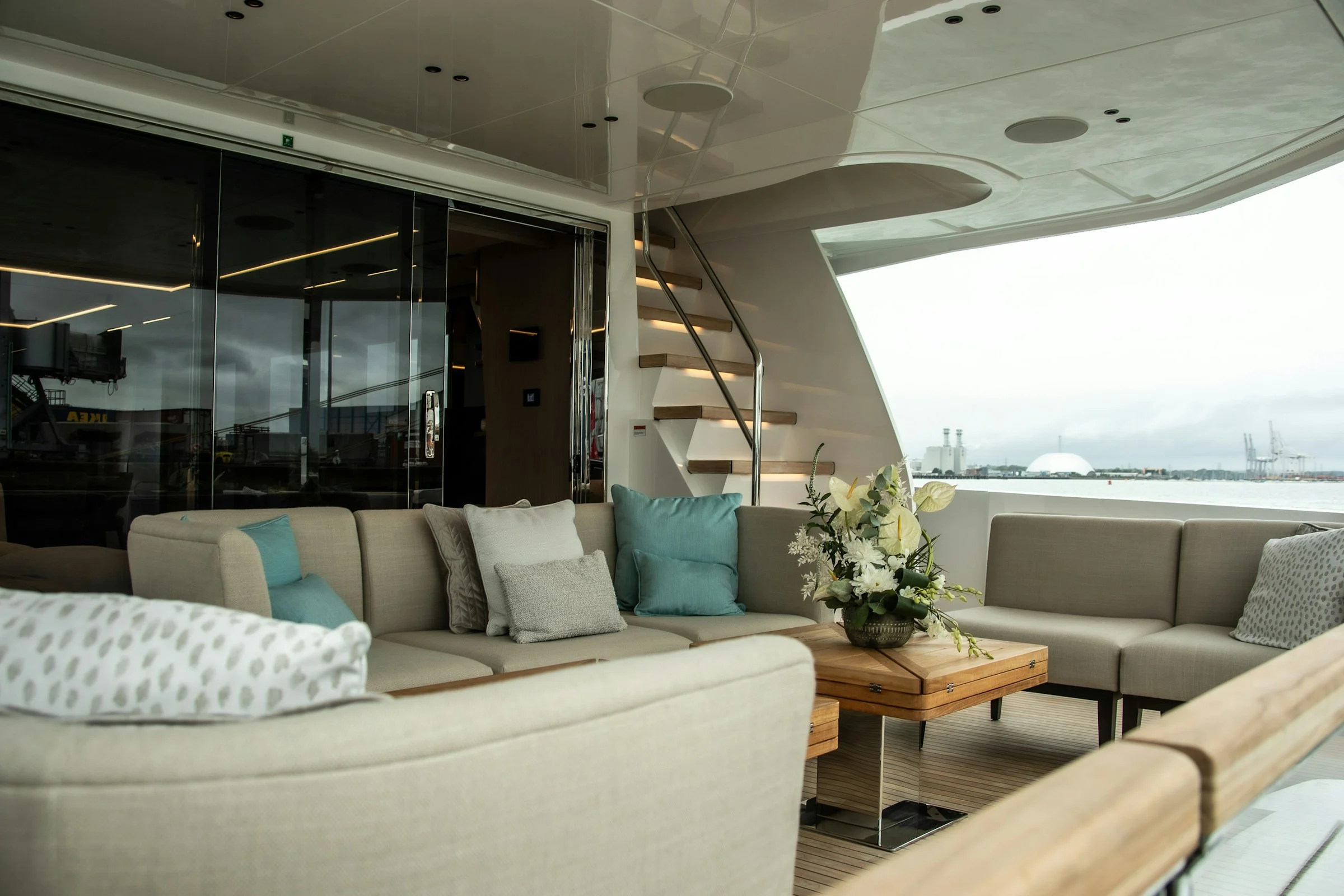
Marble restoration on board, planned around your yacht
Marble restoration on board is not the same job as restoring a floor in a villa. The stone is the same, but everything around it changes: a confined interior, joinery worth more than the marble itself, guests who may return within days, a crew with its own schedule, and a yacht that may be alongside today and at anchor tomorrow. Our marble restoration on board method was built for that reality.
The team behind LTDS Yachting comes from Les Traitements du Sud, the stone-care company that looks after yachts on the Côte d’Azur. What follows is the way we work on every yacht, whatever her size and wherever she is: nine clear steps, agreed with the captain or the chief stew before anything starts, so that nobody on board is surprised.
The nine steps of our marble restoration on board method
Every project follows the same sequence, from the first WhatsApp message to the care advice we leave with the interior team. The scope changes from one yacht to the next; the discipline does not.
- 01
First contact on WhatsApp
Most requests start with a short message from the captain, the chief stew or the yacht manager. WhatsApp suits life on board: you can write between two tasks, send a voice note and share pictures straight away. You can also use the form or call us if you prefer.
- 02
Photos, then a visit on board
A few photos of the damaged surfaces, taken in daylight and from a low angle, tell us a lot: dull areas, etch marks, chips, cracks, open joints. When the scope justifies it, a member of the team visits the yacht to check the stone, the finish and the access before quoting.
- 03
A clear, itemised quote
You receive a written quote surface by surface: which areas, which treatment, which finish, and what is excluded. A manager can forward it to the owner’s office as it is, and a captain can see at a glance what will happen in each cabin.
- 04
Choosing the place and the time with you
We decide together where the work will take place: alongside in the marina, which is the most common case; at anchor when tender access and conditions allow; in the shipyard during a refit or lay-up period; or in a workshop close to the yacht for removable pieces such as a vanity top or a table. We come to your yacht, wherever she is.
- 05
A schedule built around the crew
The planning follows the yacht’s own: between two charters, while the guests are ashore, before the season or during a refit. We agree working hours, the order of the cabins, access routes, and when noise is acceptable on the quay.
- 06
Protecting everything around the stone
Before any machine is switched on, the surrounding areas are protected: joinery, carpets, teak soles, leather, fittings and adjoining surfaces. On a yacht, protection takes as long as it needs to.
- 07
The work itself
Honing, polishing, crystallisation, repairs, etch mark removal or protective impregnation, according to the quote. Each surface is treated with the method that suits its stone and its finish, not with a single recipe for the whole yacht.
- 08
Final check with the chief stew
Before we leave, we walk through every treated area with the chief stew or the person in charge of the interior, in natural and artificial light. Any remark is dealt with there and then, and the protections are removed only once the result is accepted.
- 09
Care advice for the interior team
We leave practical advice for the crew: which products to use and which to avoid, how to deal with a spill, and when the next maintenance visit would make sense. A well-briefed interior team keeps the result for much longer.
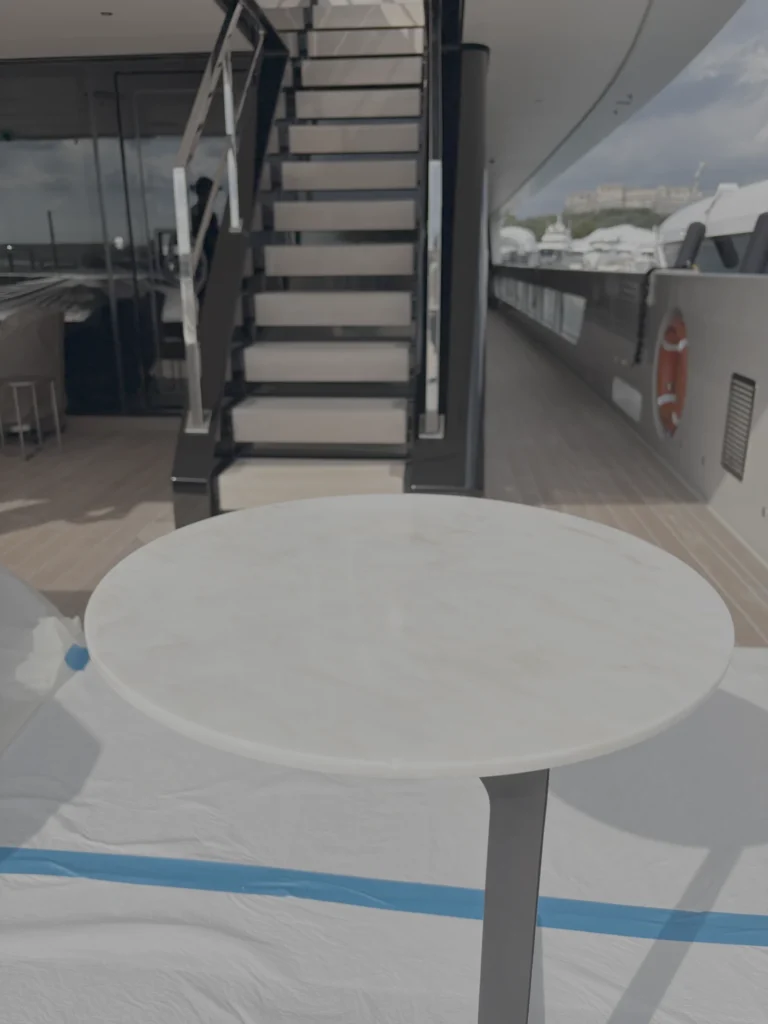
Protection comes before polishing
On a yacht, marble is surrounded by materials that are often more fragile and more expensive than the stone: lacquered or veneered joinery, silk carpets, leather, gold or chrome fittings, teak decks. Our first job is to make sure none of them is touched.
Edges are masked with tapes chosen not to leave residue on lacquer or varnish. Floors along the route between the gangway and the work area are covered. Adjoining surfaces are sheeted, and fittings that can be removed are removed with the crew’s agreement and stored where they decide. Nothing goes back into place until the final check.
Dust and slurry: controlled at the source
Dust is the first concern of every captain we speak to, and rightly so. In a confined interior with air conditioning running, fine particles travel far and settle everywhere. That is why we work wet whenever the stone allows it, and why any dry operation is done with extraction connected directly to the tool.
The slurry produced by wet honing is collected as we go, never left to dry in joints or run towards joinery. Ventilation is discussed with the engineer beforehand: some yachts prefer to isolate a deck or switch off a particular air handling zone while we work. At the end of each day, the work area is left clean and usable.
Products suited to confined spaces
The products we use on board are chosen for enclosed interiors: low-odour where possible, used in small quantities, and handled with care around fabrics and finishes. Crystallisation and impregnation products are applied only after we have checked their compatibility with the stone in an inconspicuous area.
We do not use aggressive acids or solvents in cabins where guests or crew will sleep the same night without agreeing the timing and the ventilation with you first. Safety data sheets are available to the captain or the engineer on request.
A small, discreet team
We send the number of people the job needs and no more. A small team is easier to brief, easier to accommodate on board and less disruptive for the crew. The same technicians stay on your yacht from the first day to the final check, so you always know who you are dealing with.
Our technicians are used to life on board: shoe covers or dedicated footwear, respect for crew areas, no personal phone calls in guest spaces, and quiet hours when the yacht requires them.
Confidentiality, as a matter of course
Owners value privacy, and so do we. We never publish the name of a yacht, a photograph showing her identity or a face without explicit consent. The photos in our gallery show the stone and the work, nothing else.
If your yacht or management company requires it, we sign a non-disclosure agreement before the visit. Information about the owner, the guests, the itinerary or the interior stays with the people who need it to do the job.
What the method covers
The same nine steps apply to every service we offer on board. You will find each one described in more detail on its own page:
- Marble polishing, to bring back an even shine on floors, walls and tops.
- Marble crystallisation, for a harder-wearing gloss on suitable calcareous stones.
- Marble repair: chips, cracks, tinted resin filling and worn steps.
- Etch mark and stain removal: acid etching, limescale, rust.
- Marble protection with water and oil repellent impregnation.
- Maintenance contracts, before the season, between charters and at the end of the season.
The same care applies to onyx, travertine, granite and quartzite. Whatever the surface, from marble bathrooms to staircases, the protection and dust control described above remain the same.
Questions about working on board
Can the crew carry on working while you are on board?
Yes. We agree the areas we need and the routes we use, and the rest of the yacht remains available. Most crews continue their own work around us, and we adapt the order of the cabins to their programme.
Do we need to move the yacht to a shipyard?
No. Most of our work is done alongside in the marina. We can also work at anchor when access allows, in the shipyard if the yacht is there for a refit or lay-up, or in a workshop nearby for removable pieces. You choose what suits your programme.
Will there be dust in the air conditioning?
We work wet whenever possible and use extraction at the source for any dry operation. We agree ventilation with the engineer beforehand so that dust does not reach the air handling system.
How long does a job take?
It depends on the surfaces, their condition and the finish required. The quote gives an estimated duration surface by surface, and the planning is agreed with you before we start.
Can you work between two charters?
Yes, provided the turnaround leaves enough time for the surfaces concerned. We tell you honestly what can be done in the window available and what is better kept for a longer stop.
Will you sign a non-disclosure agreement?
Yes, on request, before the visit. Yacht names and faces are never published without consent.
Who checks the result?
The chief stew, or whoever is responsible for the interior, walks through every treated area with us before the protections are removed. The job is finished when the result is accepted.
Tell us about your yacht
Send a few photos on WhatsApp: we reply with a first assessment and propose a slot that fits the crew’s schedule.