
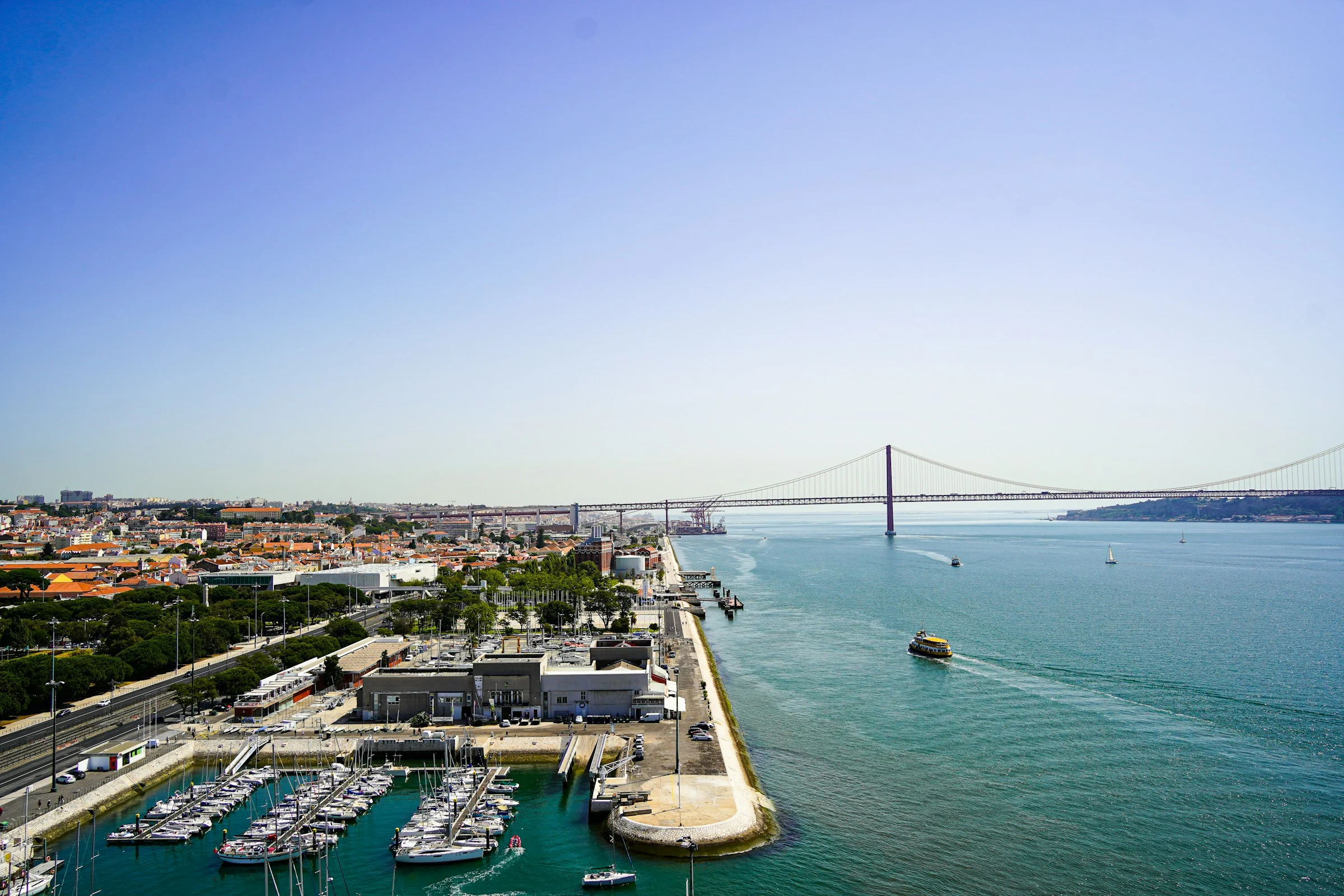
Marble on board, on a river that never stands still
Yacht marble restoration in Lisbon begins with an unusual setting: a capital city built on a tidal estuary, where yachts lie in old dock basins cut into the north bank of the Tagus rather than in one large resort marina. Our team travels to your yacht in Lisbon, in Cascais or in Oeiras, and works on her marble, onyx and natural stone wherever she is berthed.
Many of the yachts that call here are on passage. Lisbon lies on the coastal route between northern Europe and the Mediterranean, and within reach of Madeira, the Canaries and the Azores, so a yacht may come up the river after several days offshore with an interior that has been worked hard. Toiletries shifted in a seaway leave rings on a vanity, a saloon table picks up scratches from objects that slid, and a shower tray grows dull with limescale from water bunkered in a string of different ports. A few days on the Tagus are often the first calm moment to deal with it.
Other yachts come for the city. Owners and guests want Belém, Alfama, the miradouros and the restaurants, and the yacht becomes a private residence moored a short drive from all of it. When the master bathroom or the bar top has lost its finish, the crew want it corrected before the next guests step aboard, without turning the interior into a worksite.
Where we work in Lisbon: the docas, the river and the coast
Lisbon has no single superyacht marina. Berths are spread along roughly ten kilometres of riverfront and out to the coast at Cascais, each with its own access rules, so the first thing we ask is simply where your yacht is lying, or will be.
- Doca de Alcântara
- Marina Parque das Nações
- Marina de Cascais
- Marina de Oeiras
Doca de Alcântara
Doca de Alcântara is the basin the port authority usually points visiting yachts towards. It sits a short way upriver from the 25 de Abril bridge, tucked behind the container and cruise quays, with berths for yachts up to about twenty metres and good water depth. Entry is through an opening footbridge across the mouth of the basin, and the pontoons are behind coded gates. For a marble job that means we agree the access details with the crew or the marina office before we arrive, and carry our equipment along the pontoon by hand; nothing heavy, nothing that needs a vehicle on the quay.
Belém, Bom Sucesso and Santo Amaro
Downriver, the smaller docas of Bom Sucesso (near the Belém Tower), Belém and Santo Amaro (almost directly beneath the bridge) are largely taken by local boats. They matter to us mostly for smaller yachts and day boats whose owners also keep a larger yacht elsewhere: a marble-topped table or a tender console can be dealt with during the same visit.
Marina Parque das Nações
Further upriver, near the Oceanário and the Vasco da Gama bridge, Marina Parque das Nações is the largest marina in the city, with around six hundred berths in its southern basin for yachts up to about twenty-five metres. The inner basin is entered through a gate that opens during the day, and parts of it are affected by silting, so deeper-draught yachts check their berth carefully. The marina has a pier on the river side for larger yachts and a boatyard with a travel lift and maintenance area, which is useful when a removable piece of stone has to come off the boat to be worked on close by.
Cascais and Oeiras, at the mouth of the estuary
Many larger yachts choose to stay out of the river altogether. Marina de Cascais, opened in 1999 and host over the years to the America’s Cup World Series and the 2007 ISAF Sailing World Championships, has some six hundred and fifty berths; the inner berths take yachts to about twenty-five metres, while bigger yachts lie on a pontoon outside the northern breakwater. Its boatyard has a seventy-tonne travel hoist. Oeiras, halfway between Cascais and central Lisbon, is smaller and quieter, with berths to around twenty-five metres and a modest yard. We work in both, alongside or on the hard.
At anchor, and in the yards of the Tagus
Anchoring in Portuguese waters needs prior permission, and in the estuary the ebb can run at two to three knots, so tender transfers at anchor are timed around the tide; Seixal, on the south bank, is the sheltered anchorage most yachts use. When access allows, we work at anchor too. The Tagus also has commercial ship-repair yards with drydocks; Navalrocha, for instance, has handled small cruise ships of the yacht-style kind. If your yacht is hauled out or in dock during a refit period, our team works there in coordination with the yard.
Berths in Lisbon are in demand: the port authority itself has said that demand exceeds supply and has announced roughly two hundred extra berths at Doca de Pedrouços. In practice, we plan our visit around the berth you have secured rather than the other way round. We come to your yacht, wherever she is.
Our marble services for yachts in Lisbon
Every intervention is chosen after we have seen the stone, first in your photos and then on board. The usual requests on the Tagus follow the pattern of a yacht arriving from sea or preparing to leave for it.
- Marble polishing: restoring an even, deep finish to floors and vanities that have dulled after a passage, matched to the original gloss or honed look chosen by the designer.
- Marble crystallisation: a hard, bright surface for calcareous marbles on high-traffic floors, when the interior has to look its best for a stay in the city.
- Marble repair: chips on step nosings and table edges, hairline cracks, colour-matched resin filling, often the result of an object breaking loose in a seaway.
- Etch mark and stain removal: acid marks from citrus, wine or cleaning products, limescale left by hard water, rust from metal fittings.
- Marble protection: water- and oil-repellent impregnation applied before a long leg, so the stone resists what the next weeks will bring.
- Maintenance contracts: for yachts that use Lisbon or Cascais as a regular stop, with visits planned on each call.
The same care applies to onyx, travertine, granite and quartzite. Onyx, often backlit in yacht bathrooms, is softer and more fragile than most marbles and is handled with particular caution.
Fine dust, contained at the source
Honing and polishing are done with dust extraction at the tool, and the surrounding joinery, carpets and soft furnishings are masked before we start. In a dock basin with neighbours a few metres away, that also keeps the work invisible from the pontoon.
Products are chosen for confined interiors, and a small, discreet team keeps the footprint on board to a minimum. A non-disclosure agreement is available on request.
Season and planning in Lisbon
Lisbon’s calendar is shaped less by a local charter season than by yacht movements along the Atlantic coast.
Spring. Yachts returning from the Caribbean usually cross eastward in April or May, often by way of the Azores, and a mainland call on the Portuguese coast is a natural moment to reset the interior before the Mediterranean summer. Spring is also boat-show time: Nauticampo, the Portuguese nautical show, is held at FIL in Parque das Nações, next to the marina (11 to 15 March in 2026).
Summer. The city and Cascais are busy, with regattas off the coast and guests on board. Work then fits around the guest programme: a bathroom while the owner is ashore, a bar top in the morning before the yacht goes out.
Autumn. Westbound transatlantic crossings generally leave Europe towards the end of November, with stops at Gibraltar or the Canaries. Yachts passing Lisbon on their way south have a window to have marble protected before weeks of humidity, salt air and heavy use in the Caribbean.
Winter. Some yachts winter on the Tagus or at Cascais, and marinas such as Parque das Nações offer reduced winter rates. A yacht with her guests away is the ideal subject for larger jobs: full floors, staircases, a complete bathroom.
Tell us your window, even a short one, and we build the job around it. The guide on when to schedule marble restoration goes into the timing in more detail.
Surfaces we restore on board
On yachts calling at Lisbon, the damage we see is linked to time at sea as much as to guest use.
- Marble bathrooms: vanities, shower floors and walls, where limescale and toiletries do most of the harm.
- Marble floors: saloons, lobbies and passageways, worn along the lines people walk.
- Bar tops, counters and tables: etch rings from glasses, scratches, chipped edges.
- Marble stairs: nosings chipped by luggage and provisioning, treads polished slippery or worn dull.
How a job on the Tagus runs
- 01
Photos and berth
Send photos of the stone by WhatsApp, with the name of your marina or dock and your dates. If the yacht is still at sea, we plan from her expected arrival.
- 02
Access agreed
We confirm gate codes, the bridge at Alcântara or the gate at Parque das Nações, and the time the crew can receive us, so nothing is improvised on the day.
- 03
Protection and work
Surrounding areas are masked, dust is extracted at the tool, and the work follows the crew’s schedule, around guests and provisioning.
- 04
Check and advice
The result is checked with the chief stew or the captain, and we leave simple care instructions for the next passage.
Lisbon: questions from captains and crew
Can you work at Doca de Alcântara with the opening bridge and coded gates?
Yes. Our equipment is portable and carried by hand, so the pontoons are no obstacle. We only need the crew to confirm the access arrangements and the time we can come aboard; the bridge opening concerns the yacht, not our team.
Our yacht is too large for the inner docas. Where can the work be done?
Wherever she lies: on the outer pontoon at Cascais, on the river pier at Parque das Nações, at anchor with permission, or in a yard. The location changes the logistics, not the result.
We are only stopping in Lisbon for a few days before heading to Madeira or the Canaries. Is that enough?
Often, yes, for targeted work such as an etched vanity, a chipped step or protecting a bathroom before the crossing. Send photos before you arrive so we can tell you honestly what fits in your stop and what is better left for a longer one.
Can you work while the yacht is at anchor off Seixal or elsewhere in the estuary?
When access by tender is practical, yes. In the Tagus the ebb runs strongly, so we time transfers with the crew and keep equipment light.
Can marble work be scheduled while the yacht is wintering at Cascais or Parque das Nações?
Winter is the best time for large surfaces. We can work alongside, on the hard, or in a workshop near the yacht for removable pieces, and coordinate with any other contractors on board.
Do you have an office in Lisbon?
No. Our team travels to your yacht in Lisbon from the Côte d’Azur, where Les Traitements du Sud looks after the stone on yachts. There is no local address or local number: one WhatsApp line handles every port.
Interventions are carried out today by the travelling team of Les Traitements du Sud, the stone-care company that looks after yachts on the Côte d’Azur. See also our Portugal page and the Algarve page.
Works in Lisbon are carried out by Les Traitements du Sud (France), travelling team.
Your yacht is on the Tagus or heading there?
Send us a few photos and your berth. We reply with an honest assessment and a plan that fits your stay.